Simulation Toolbox

ROSCon 2026 · Toronto, Canada · 22–24 September 2026

Simulation ToolboxGearing up for robotics

Slides, links and practice resources from the session.

  1. ToolboxLearn which simulators fit your problem and why.
  2. StandardsReuse simulation workloads and assets.
  3. PracticeFine-tune a humanoid walking policy and take the resources home.

A simplified cheat sheet

My problemCandidatesDeciding factor
Software-in-the-loop stack testsGazebo, O3DE, Isaac SimControl, sensors, photorealism
Train a policyMuJoCo / Playground, Genesis World, Isaac LabTask and compute backend
Large, rich scenesO3DE, UnrealAuthoring and performance
Custom physicsNewton, Genesis World, MuJoCo (backends)Required solver features
Policy benchmarksLIBERO, ManiSkill task suitesBenchmark fit
Software-in-the-loop vs robot learning
Software-in-the-loopRobot learning
GoalReplace hardware for development and full use-case testingTeach a skill, usually with an isolated task
PerformanceScene complexity, sensor fidelity and volume, robot countTime to train, GPU batching and parallel environments
APIsROS, sockets and drivers; distributed communicationIn-memory tensors; no middleware in the rollout loop
TimeSimulation drives the clock for the application stackThe learning algorithm steps the simulation
ScalingHeadless test jobs across cloud workers; real-time factorVectorized environment instances on the GPU

The toolbox versions as of 17 September 2026

Gazebo

Jetty LTS · 2025-09

Great support for ROS packages
Pairs with ROS 2 Jazzy and later. Most ROS packages ship Gazebo examples; ros_gz bridges topics and services.
Composable simulation
Swap physics, rendering and sensors as plugins.
Community standard
SDFormat, Fuel asset library, Python bindings; Zenoh transport in Jetty for ROS 2 interoperability. Jetty ships the Simulation Interfaces implementation.
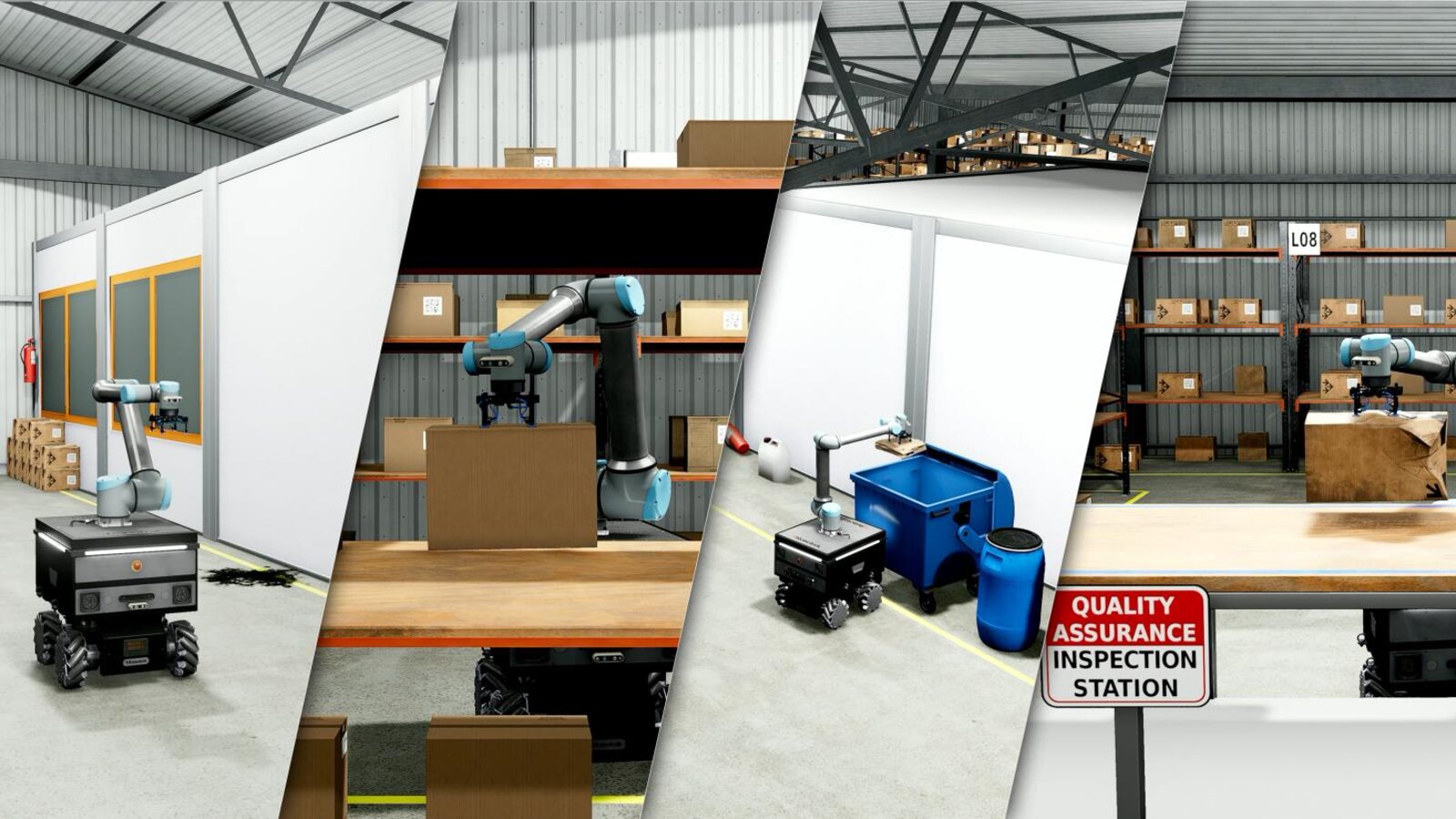
O3DE · Open 3D Engine

26.05.0 · 2026-05-27

Operational environments
Editor, prefabs and scripted behaviors model facilities and interacting subsystems.
Native ROS 2
Custom messages, services and actions use ROS APIs directly. Built-in TF, time and namespaces, Nav2 and MoveIt.
Focused
No support for robot learning; great for development, software-in-the-loop and operations.

Newton

1.6.0 · 2026-09

OpenUSD + MuJoCo + Warp
An extensible GPU physics engine under the Linux Foundation.
Extensible physics
Warp kernels and solver selection; deformables, gradients, constraints, material coupling.
Under LF but backend lock-in
Requires Warp (CUDA JIT), so an NVIDIA backend.

Genesis World

1.4.1 · 2026-09-12

Coupled physics
Rigid, FEM, MPM and PBD/SPH solvers share one scene; explicit, SAP or IPC couplers resolve contact between them.
Task variation at scale
Parallel and heterogeneous environments, domain randomization, batched IK and planning.
Beyond state-only policies
Cameras (path-traced or raster), lidar, IMU, contact-force and tactile taxel grids; differentiable by design.

Other tools

Learning and evaluation

  • Schola

    Unreal-to-Python RL integration with vectorized and multi-agent workflows. Useful for authored training environments.

  • SAPIEN + ManiSkill

    Articulated-object manipulation, including visual observations. ManiSkill adds tasks, datasets and learning infrastructure.

  • LIBERO

    Tests transfer across objects, spatial layouts and task goals. Useful when policy evaluation needs a defined manipulation suite.

Robotics and world building

  • Drake

    Manipulation with contact-rich physics, plus planning, trajectory optimization and controller design. Built for optimization rather than rollouts; gradients built in.

  • Webots

    Robot models, sensors and controllers in an integrated environment. Useful for prototyping and repeatable controller experiments.

  • Unreal Engine

    Detailed environments, behavior authoring and visual simulation. Matters for photorealism.

  • Unity

    Existing projects can reuse ros2-for-unity (no longer supported by Robotec.ai).

Standards

OpenUSD · REP-158 In vote

  1. Upstream standards and sim-ready assetsAdopt OpenUSD standard and SimReady practices, modular composition, neutral physics plus optional simulator-specific layers.
  2. Declarative ROS schemasTopics, services, actions and frames in the asset, independent of the simulator's implementation.
  3. Compatibility and downstream exportEfficient glTF and URDF export through material, geometry, instancing and variant rules.
  4. A shared ecosystemCore schemas, extension registries and compliance tooling so assets can be checked and reused.

Practice · fine-tune a humanoid walking policy

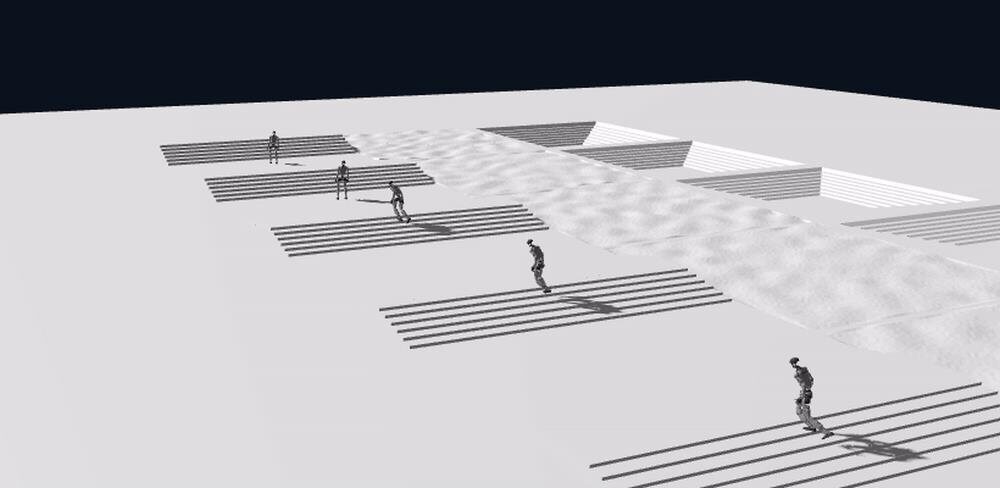
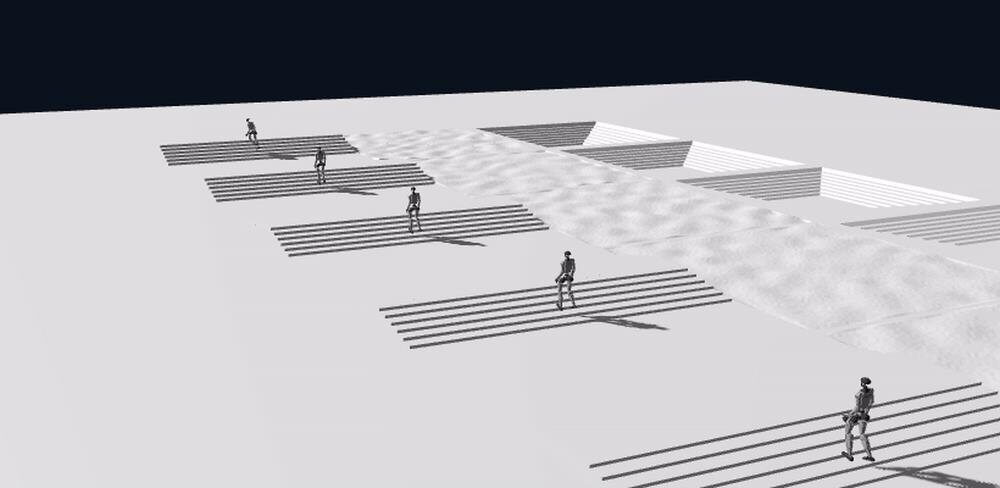
Started from a policy trained for flat ground. Increasingly difficult stairs. Compare both policies in the same evaluation setup.

Humanoid locomotion · training

Terrain, rewards, curriculum and PPO fine-tuning. Start it first and let it train in the background.

Link to be published

Humanoid locomotion · evaluation

Visualise the generated terrain, measure fall rate across difficulty levels and compare baseline against fine-tuned.

Link to be published

Changes – tuning

Terrain and curriculum
Introduce the new conditions and control their difficulty.
Rewards
Revisit foot clearance and body orientation.
Observations
Review terrain and foot-height information available to the policy.

Fall rate across all terrain difficulty levels reduced from 24% to 1–2%
Same terrain, commands, camera and duration for both policies. Compare falls, foot clearance, slip and body orientation.

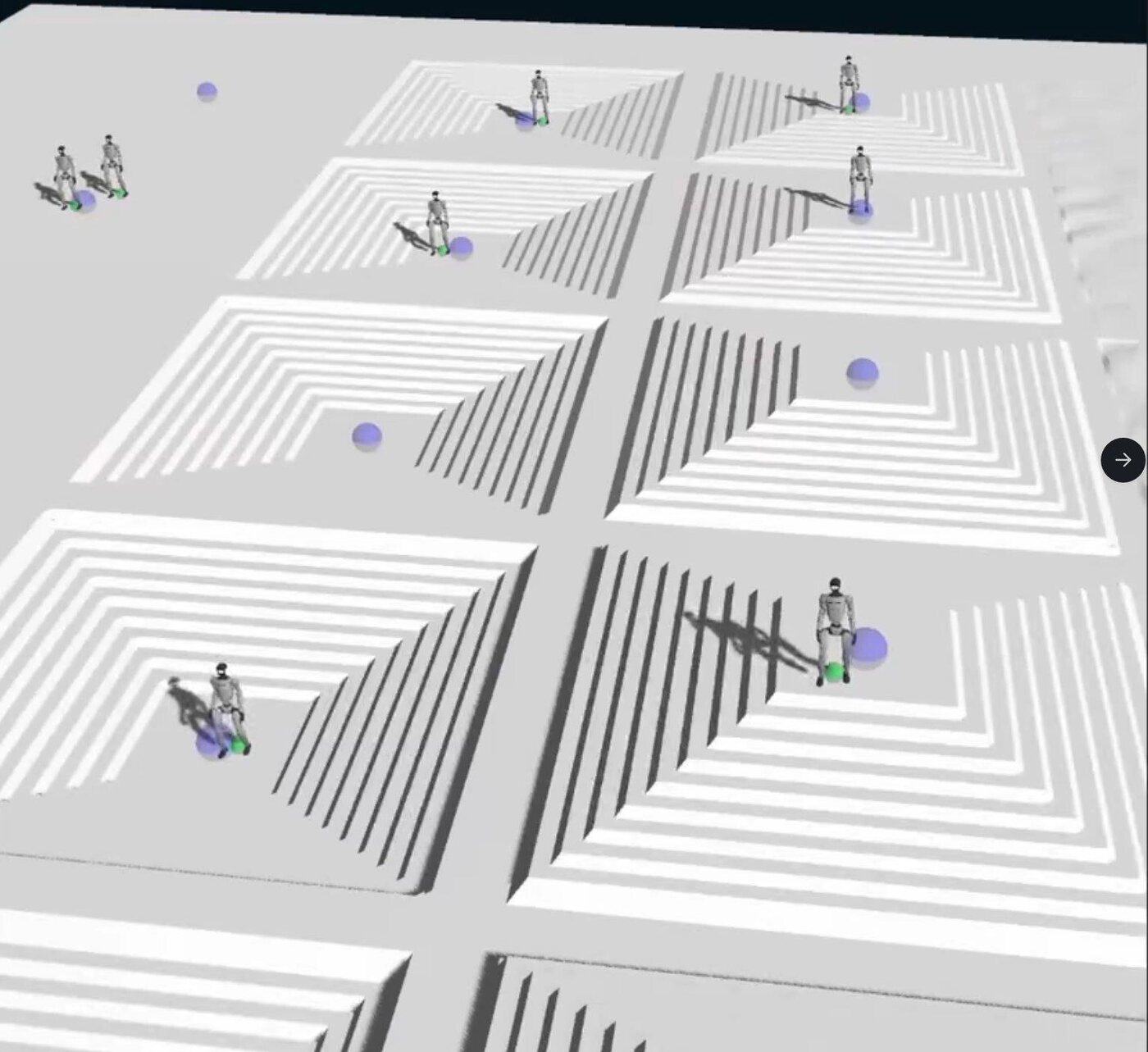
Procedurally generated stair terrains of increasing difficulty
Terrain curriculum — stairs of increasing difficulty.
Baseline policy rollout on stairs
Baseline (flat-ground policy)
Fine-tuned policy rollout on stairs
Fine-tuned

Talks and further reading

Sharing and Q&A

  • What is hard to simulate?
  • What did you use successfully?
  • What are the gaps for co-simulation?
QR code linking to this page
This page